AQI & India - Veils of Pollution
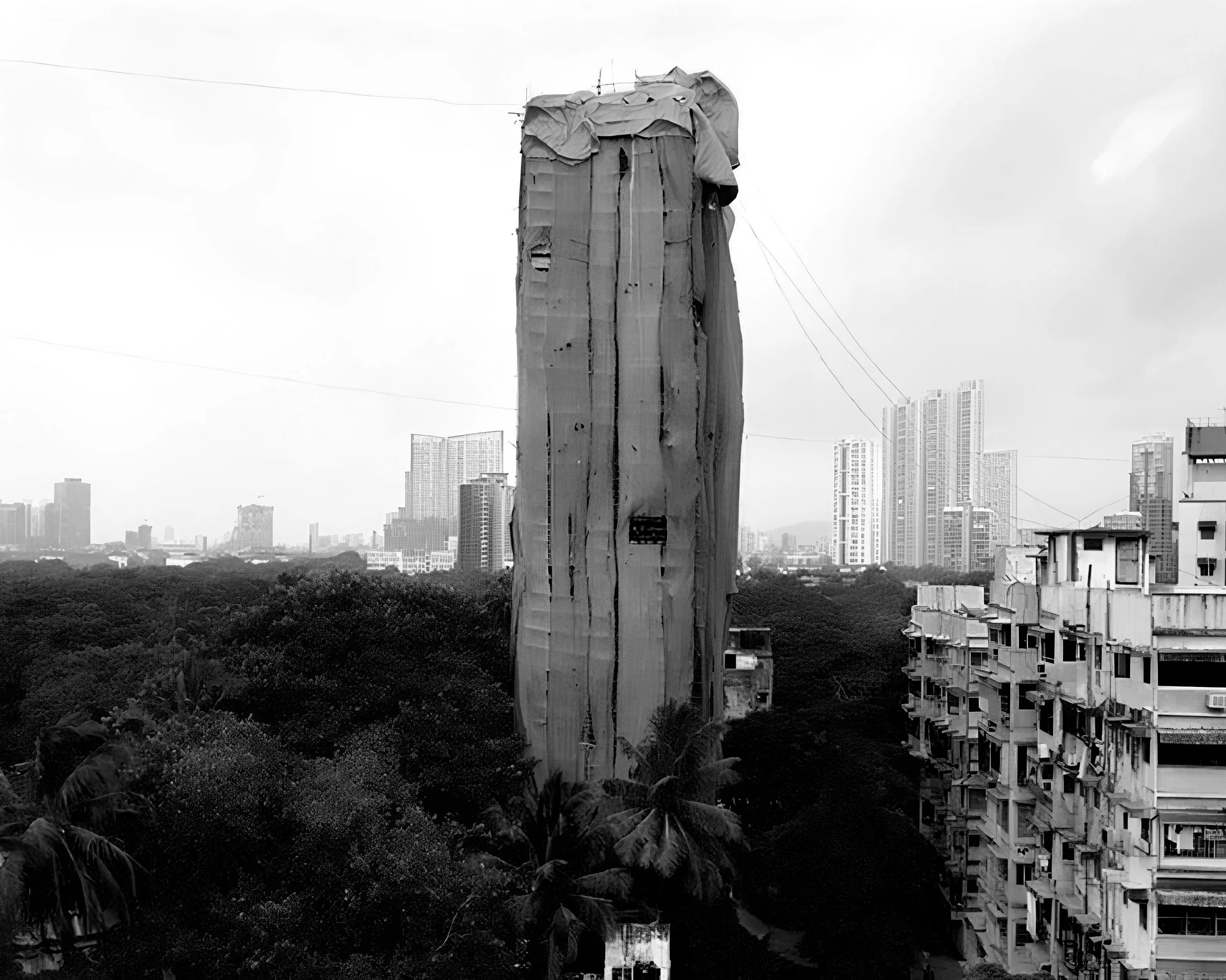
The city of Mumbai increasingly resembles an active construction site. Amid an ongoing real-estate boom, it is difficult to move through the city without encountering excavations, demolition pits, or partially erected concrete frames. Entire floors and columns are routinely veiled behind green mesh fabric—an otherwise banal material that has become ubiquitous. These screens are often read as emblems of progress or development, yet they also signal a city caught in a recursive cycle of construction, demolition, and rebuilding. The air itself bears evidence of this condition, layered with red soil and fine construction dust. The boundary separating construction from everyday life is no longer a wall but a thin veil.
Architectural theory has long been preoccupied with the completed building and the finished city, rarely attending to construction as a continuous spatial condition. Beneath these temporary barriers, however, lies a deeper problem: construction and demolition debris as a permanent environmental presence rather than a transient phase.
Actual Barriers
In Mumbai, environmental regulation has produced a new architectural condition: the permanent screen. Green dust nets, corrugated metal sheets, and mist-spraying devices are deployed to prevent construction activity from visibly contaminating the city. Construction debris is directly linked to spikes in air-quality indices, contributing significantly to PM2.5 and PM10 concentrations. Originally introduced as temporary dust-control measures, these nets have gradually taken on additional roles—functioning as shading devices, safety barriers, and visual covers.
Yet their most consequential function is concealment. Migrant labor, informal work rhythms, and unsafe practices are rendered invisible from the street. Pollution, in this regime, is managed first as an image and only secondarily as a condition. The screen allows construction to continue uninterrupted while projecting an appearance of environmental responsibility.
Boundary of Compliance
While construction hoardings and safety screens have been discussed within planning, environmental control, and urban branding literature, their role as architectural devices of opacity—regulating visibility, accountability, and legal legibility—remains largely unexamined, particularly in postcolonial megacities such as Mumbai.
Legal disputes surrounding construction screens rarely address their actual environmental effectiveness. Instead, they tend to focus on visibility, coverage, and procedural adequacy. As a result, the net functions less as a dust-control device and more as a juridical surface: a material interface that translates atmospheric harm into an inspectable image.
Construction workers labor inside these screened enclosures, breathing dust long before it disperses into the surrounding city. Respiratory illness, silicosis, and chronic exposure are well documented, yet labor safety remains largely disconnected from environmental regulation. The screen thus mediates not only air and dust, but also responsibility.
Gaps in Regulation
Despite the construction sector’s substantial contribution to particulate pollution, the Government of India’s regulatory response to construction and demolition dust remains fragmented and largely symbolic. Multiple laws, advisories, and guidelines addressing PM2.5 and PM10 emissions exist across central and state frameworks, yet they are scattered, inconsistently enforced, and often reduced to nominal compliance. Control measures, therefore, operate primarily at the level of appearance rather than impact, allowing construction activity to proceed while responsibility for managing dust is displaced onto temporary, surface-level interventions.
In Mumbai, dust-control nets—introduced as provisional environmental safeguards—have become permanent architectural membranes. They transform the wall from a solid boundary into a continuous filter that manages visibility, pollution, and accountability in a city under constant construction.