The India–Pakistan border was drawn in 1947 by Cyril Radcliffe, a London barrister with no experience in South Asia, working under an impossible five-week deadline. The Radcliffe Line was cartographic violence, an abstract boundary that cut through villages, fields, and families. It triggered a two-way exodus of nearly 15 million people that claimed almost two million lives. This invisible line became one of the world’s most militarized borders, and the Wagah checkpoint emerged as its theatrical centerpiece, a site where bilateral political gestures take place.
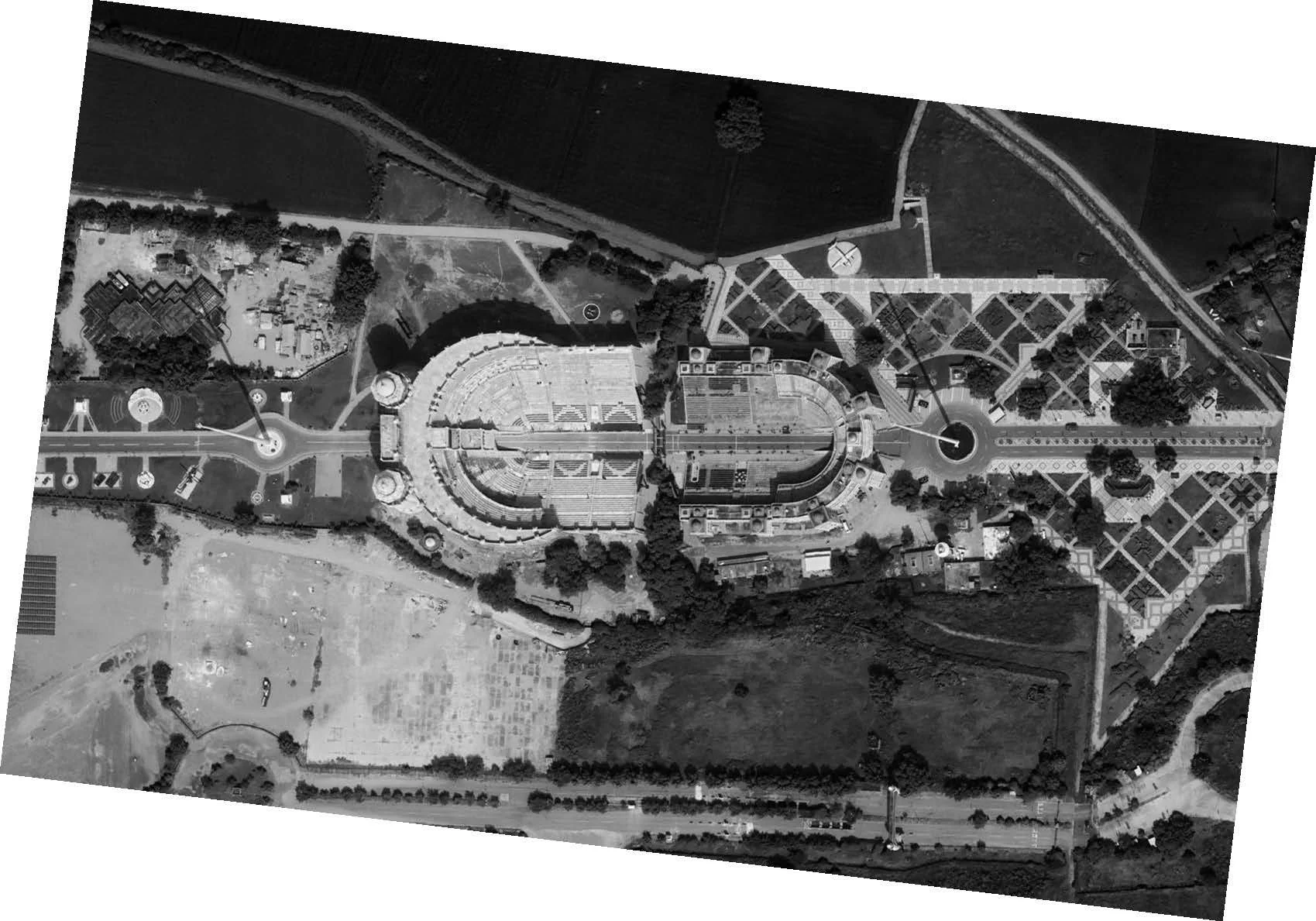
Before 2010, the Wagah border crossing consisted of scattered tourist structures and a small grandstand on the Pakistani side; after 2015, both sides expanded their presence to one-up each other’s scale and accommodate larger crowds. Seen from above, the site today features semicircular grandstands on both sides of the border, resembling a bifurcated Roman circus. On the Pakistani side, the entrance is articulated by minarets, while the Indian side presents a comparable assembly of chhatri-like domes. A clear axial road runs through the middle of the circus and the gates of the respective states. Each evening, both gates are slammed shut with deliberate force, boots strike the ground in an exaggerated rhythm, and flags descend in synchronized motion. Spectators seated on their respective sides primarily watch the performance of their national soldiers. The opposing side remains visible, but the grandstands orient attention inward, producing parallel scenes of spectatorship.
The border evolves through competitive repetition. mimetic escalation manifests the long-standing and unresolved tensions between the two states. Wagah renders sovereignty legible not through administration alone but through symmetry, with the border as the axis of reflection. The performance appears to be for its own audience, yet it would not be complete without its counterpart. The other side is necessary, but never directly addressed. The performance creates the illusion of political engagement, yet the spectacle itself becomes a performative barrier. The thickened zone of nationalism entangles both sides in a distancing tension.
– Santhosh Narayanan Sridhar
This Aerial view of Grand Trunk Road as it cuts through the Wagah border between India and Pakistan, Sept ember 2025. Image: Google Earth.